
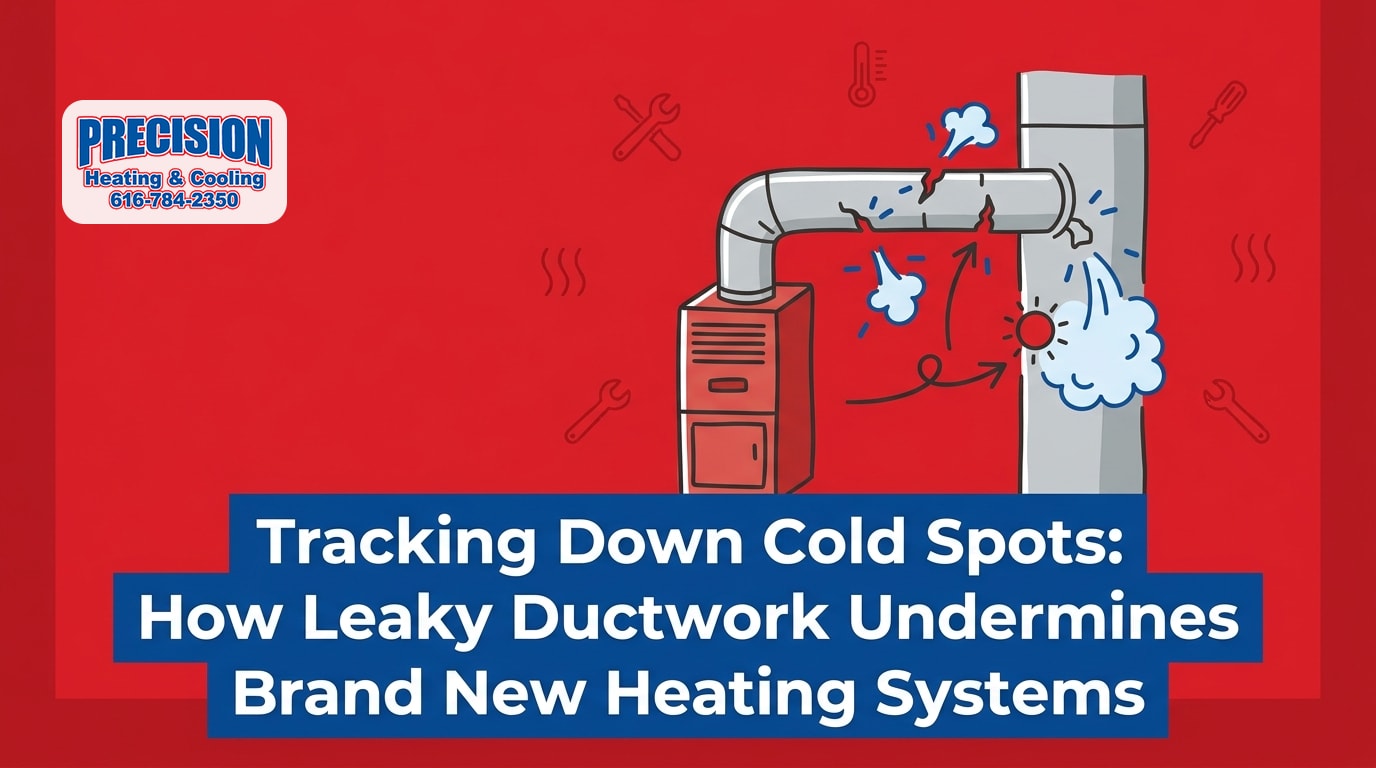
The Frustration of Freezing Rooms After a Heating Upgrade
At Precision Heating & Cooling, we know that Tracking Down Cold Spots: How Leaky Ductwork Undermines Brand New Heating Systems is a frustrating reality for many homeowners who expect instant comfort from their recent investments. Your new furnace is running quietly in the basement, but the back bedroom still feels like an icebox. You just invested in a top-of-the-line heating unit, yet you are still wearing heavy sweaters indoors and avoiding certain rooms entirely. This creates a highly confusing situation for any homeowner. It forces a tough decision: do you keep calling the installer to blame the new equipment, or is it time to investigate the hidden pathways carrying that heated air?
If you are tired of uneven temperatures and constantly adjusting the thermostat, our team’s heating and furnace services and Aeroseal duct sealing can help you find the real culprit.
The root of this frustration usually comes down to a simple misunderstanding of how central heating works. A furnace is simply the heat generator. It warms the air, but it relies entirely on your home’s ductwork to act as the delivery system. If the delivery system is compromised, the generator’s efficiency simply does not matter. The hot air never reaches its final destination.
Our technicians typically see this problem become painfully obvious during November pre-winter temperature drops. As late fall weather sets in and the outdoor air gets significantly colder, it creates a sharp thermal contrast against your heated indoor air. This sudden shift instantly exposes any hidden distribution flaws in your home. Minor drafts that were barely noticeable in October suddenly turn into freezing cold spots by Thanksgiving.
Common signs we look for that indicate your delivery system is failing include:
- Inconsistent airflow: One vent blows forcefully while the next room over barely produces a breeze.
- Rapid temperature drops: Rooms that lose heat the moment the furnace cycles off.
- Dust buildup: Excessive dust gathering around specific vents, indicating air is being pulled from unconditioned spaces.
- Struggling to reach set temperatures: The thermostat says it is heating, but the room thermometer reads several degrees lower.
Instead of continuously cranking up the thermostat and forcing your new system into overdrive, we recommend diagnosing the hidden pressure loss. Once you understand how the air travels, you can fix the actual problem.
The Physics of Airflow: Why Your New Furnace Needs a Sealed Path
To understand why cold spots happen, we have to look at the basic physics of how air moves through a house. Modern furnaces are engineered to be incredibly efficient, but they rely on precise static pressure to push conditioned air to the furthest reaches of the home. Static pressure is essentially the resistance that the blower motor must push against to distribute air evenly. If that pressure drops unexpectedly, the air loses its momentum.
Think of your ductwork like a garden hose attached to a high-pressure spigot. If you turn on the water, you expect a strong stream out of the nozzle. But if that hose has dozens of tiny punctures along its length, water will spray out into the yard long before it reaches the end. By the time the water gets to the nozzle, it is nothing but a weak trickle. Your ductwork operates on the exact same principle. Older, leaky ductwork acts like a punctured hose, bleeding off essential air pressure before the heat can ever reach your distant bedrooms or upper floors.
The statistics on this are staggering. According to ENERGY STAR, 20 to 30 percent of the air moving through a typical residential duct system is lost to leaks, holes, and poorly connected joints. That means up to one-third of the heat you are paying to generate is completely vanishing before it ever reaches your living space.
In our years of servicing local homes, we’ve found that many homeowners in Comstock Park MI assume that upgrading to a powerful new furnace will solve their airflow problems. Unfortunately, installing a new, high-efficiency blower on an old, leaky duct system often exacerbates the pressure issues. The stronger motor simply pushes air out of the leaks faster, making the system run louder without actually improving the comfort in those distant rooms. This is why a comprehensive approach to ductwork and ventilation services is non-negotiable for true comfort.
Understanding Hidden Pressure Loss
Air is fundamentally lazy; it will always take the path of least resistance. When a duct has a loose connection or a cracked seam, the heated air escapes into attics, crawlspaces, and empty wall cavities rather than pushing all the way to the vent.
Because the air is escaping early in the run, the rooms located at the very end of the duct line starve for airflow. This pressure drop is the exact scientific reason behind the dreaded cold spots. The furnace is doing its job perfectly, but the structural integrity of the home’s ductwork is failing to deliver the payload.
| System Condition | Airflow Delivery | System Strain | Comfort Level |
|---|---|---|---|
| Fully Sealed Ducts | 100% of heated air reaches vents | Normal operating pressure | Even temperatures in all rooms |
| Moderate Leaks (15% loss) | Noticeable drop at distant vents | Slightly elevated run times | Mild cold spots in corner rooms |
| Severe Leaks (30%+ loss) | Barely any air reaches distant vents | High strain, frequent short-cycling | Freezing rooms, high utility bills |

Treating the Symptom vs. Curing the Cause
When a room feels too cold, human instinct kicks in immediately. The most common reaction is to walk over to the thermostat and push the temperature up a few degrees. While this might temporarily force a little extra heat into that freezing back bedroom, it is the textbook definition of treating a symptom while ignoring the underlying cause.
A pattern we see often on our late fall service calls is what actually happens when you try to out-heat a leaky duct system:
- The furnace short-cycles: The rooms closest to the thermostat heat up incredibly fast. The thermostat reads that the house is warm and shuts the system off. Minutes later, the distant cold rooms pull the overall house temperature down, and the furnace kicks right back on. This rapid on-and-off process is called short-cycling.
- Premature wear and tear: A furnace uses the most energy and sustains the most physical wear during the startup phase. Short-cycling forces the blower motor and heat exchanger to work overtime, significantly shortening the lifespan of your brand-new equipment.
- Overheating the core: Because the air is not flowing properly through the entire system, heat can build up inside the furnace cabinet, causing the high-limit switch to trip and shut down the unit to prevent a fire hazard.
- Wasted utility spend: You are essentially paying to heat the inside of your walls, your floors, or your attic space. The energy meter spins, but your living room stays chilly.
Especially during those harsh November pre-winter temperature drops, trying to force a broken delivery system to work by adding more heat simply does not make sense. It wastes energy and damages your investment. Proper diagnosis of the airflow restriction is required to achieve true comfort and system longevity. Implementing real energy efficiency solutions means looking at the house as a complete, interconnected system rather than just a collection of separate appliances.
Why Traditional Manual Sealing Methods Fall Short
Once homeowners realize their ductwork is leaking, the next logical step is to look for a way to seal it. For decades, the standard industry practice involved traditional manual sealing methods. Contractors would climb into a basement or crawlspace with buckets of mastic sealant and rolls of specialized foil tape, painting over every joint and seam they could find.
While mastic and tape are excellent products for certain applications, they have one massive physical limitation: manual sealing can only address exposed ductwork. If a duct is running across an unfinished basement ceiling, a technician can easily seal it by hand. But that only accounts for a fraction of the total system.
The hidden challenges of manual duct sealing include:
- Inaccessible runs: The vast majority of a home’s ductwork is completely hidden behind finished drywall, tucked between floor joists, or buried under attic insulation.
- Blind spots: Even in exposed areas, the tops and backs of the duct trunks are often pushed tight against the floorboards, making it impossible for a human hand to reach around and apply tape.
- Deterioration over time: Older tapes and cheap sealants can dry out, become brittle, and peel away after years of expanding and contracting with temperature changes.
Attempting DIY fixes on these hidden ducts is physically impossible without tearing open your walls and ceilings. You cannot tape a leak you cannot reach. For many homes we inspect in Comstock Park MI, where complex duct systems snake through multiple stories and finished basements, manual sealing only solves about twenty percent of the actual leakage problem. To fix the hidden leaks, you need a solution that works from the inside out.
The Inside-Out Solution: Advanced Duct Sealing Technology
In our years of experience diagnosing underperforming heating systems, the Precision Heating & Cooling team frequently finds that standard HVAC contractors miss this crucial step. They install a beautiful new furnace, see that the exposed ducts look fine, and move on. But our specialized expertise and equipment for Aeroseal duct sealing allow us to address the hidden leaks that others leave behind.
Aeroseal is an advanced technology that completely changes how we approach pressure loss. Instead of trying to find leaks from the outside, this method pressurizes the entire duct system to find the leaks automatically from the inside. It is a precise, computer-controlled process that requires specific training to execute correctly.
How the advanced sealing process works:
- System Isolation: First, we block off all the registers and vents in the home to isolate the ductwork from the living spaces.
- Pressurization and Measurement: We connect specialized equipment to the main trunk line and pressurize the system. A computer measures exactly how much air is escaping, giving us a baseline leakage rate.
- Vaporizing the Sealant: We inject a fog of suspended polymer particles into the pressurized ductwork.
- Targeted Sealing: Because the air is under pressure, it forces its way out through the hidden cracks and holes. As the air escapes, the polymer particles catch on the edges of the leaks, building up and permanently bonding together until the hole is completely sealed.
- Final Verification: The computer tracks the progress in real-time, providing a measurable, verified improvement in airflow and static pressure when the job is done.
This process seals leaks up to 5/8 of an inch wide without damaging walls, tearing up floors, or leaving a mess in your home. It is a permanent fix that transforms how your heating system performs. If you want to understand the long-term financial impact of this technology, exploring how Aeroseal saves energy and money reveals just how quickly the process pays for itself by reducing wasted heat.
Restoring Whole-Home Comfort Before Winter Arrives
Timing is everything when it comes to home comfort. Michigan winters demand peak performance from your heating equipment, and a fully sealed distribution system is the only way to guarantee comfort when temperatures drop below freezing. Waiting until January to address cold spots means living through months of frustration and inflated utility bills.
By taking action during those November pre-winter temperature drops, you ensure your home is ready for the deep freeze. We always recommend our Comstock Park customers pair a brand new furnace with a tightly sealed duct system to deliver incredible results.
The benefits of a fully sealed heating system include:
- Even temperatures: No more freezing back bedrooms or boiling hot living rooms; the heat distributes evenly across every square foot.
- Lower utility costs: When 100 percent of the heated air reaches your living space, the furnace runs for shorter cycles, consuming far less fuel.
- Quiet operation: A balanced system doesn’t have to strain against pressure imbalances, resulting in a whisper-quiet airflow.
- Better air quality: Sealing leaks prevents dusty, dirty air from being sucked in from the attic or crawlspace.
Additionally, because duct sealing significantly improves home energy performance, generic energy rebates or local utility incentives may sometimes be available for these types of efficiency upgrades. It is always worth checking with your local utility provider to see if your home qualifies for programs that reward proactive energy conservation.
Frequently Asked Questions About Uneven Heating and Ductwork
Why is my new furnace not heating the whole house?
Your new furnace is likely functioning perfectly, but it relies on your ductwork to deliver the heat. If your home has aging, leaky ducts, the heated air escapes into walls and attics before it reaches distant rooms. A new furnace cannot overcome severe pressure loss in the distribution system. Professional testing is required to measure this hidden airflow loss.
Can leaky ductwork cause uneven heating?
Yes, leaky ductwork is the primary cause of uneven heating in most homes we inspect. When air escapes through unsealed joints and cracks, the system loses the static pressure needed to push air to the furthest vents. This results in the rooms closest to the furnace being too hot, while distant rooms remain freezing cold.
Why are the rooms farthest from the furnace always cold?
Rooms farthest from the furnace suffer the most because the air has to travel the longest distance through the ductwork. Every small leak along that long path bleeds off a little bit of air pressure. By the time the duct reaches the farthest room, there is not enough pressure left to push a meaningful amount of warm air through the vent.
How do professionals find leaks in hidden ductwork?
Professionals use computerized diagnostic equipment to pressurize the entire duct system. By blocking off the vents and forcing air into the trunks, they can precisely measure the rate of pressure drop. This technology allows technicians to calculate exactly how much air is leaking behind walls and under floors without having to tear open the drywall to look for the holes visually.
Is professional duct sealing worth the investment?
Professional duct sealing is one of the most effective home performance investments you can make. By preventing 20 to 30 percent of your heated air from escaping into unconditioned spaces, it drastically lowers your monthly utility bills. Furthermore, it protects your expensive furnace from the premature wear and tear caused by short-cycling, extending the life of your equipment.
Will fixing my ductwork help my new furnace last longer?
Absolutely. When your ductwork is fully sealed, your furnace does not have to work nearly as hard to heat the home. It runs in smooth, normal cycles rather than constantly turning on and off to compensate for lost air. Reducing this mechanical strain protects the blower motor and the heat exchanger, ensuring your new unit lasts for its full expected lifespan.
Stop Blaming Your Furnace and Start Fixing Your Airflow
Ultimately, a state-of-the-art heating system is only as good as the network delivering its air. If you are constantly adjusting the thermostat and shivering in certain rooms, it is time to stop blaming the new equipment and start looking at the hidden pathways behind your walls. In our extensive Aeroseal application experience across Comstock Park, our technicians have seen countless homeowners transform their daily comfort simply by addressing these unseen pressure drops.
Do not let another winter pass with half of your house feeling uncomfortably cold. Getting your ductwork professionally tested will reveal exactly where your heat is escaping and provide a clear path forward. To learn more about how advanced inside-out sealing can restore your home’s comfort, explore our Aeroseal duct sealing solutions and take control of your airflow today.